

Day 34. Hormuz is still shut.
Yesterday at 12:37 PM ET, the market suddenly decided it wasn’t.
Two minutes later, ZeroHedge dropped the “peace” headline.
The news didn’t move the market. The market moved the news.
What Actually Happened
S&P ripped +2.9%. Nasdaq +3.8%. Call options flooded in. VIX got crushed. By afternoon, FinTwit was calling it a ceasefire rally.
There was no ceasefire.
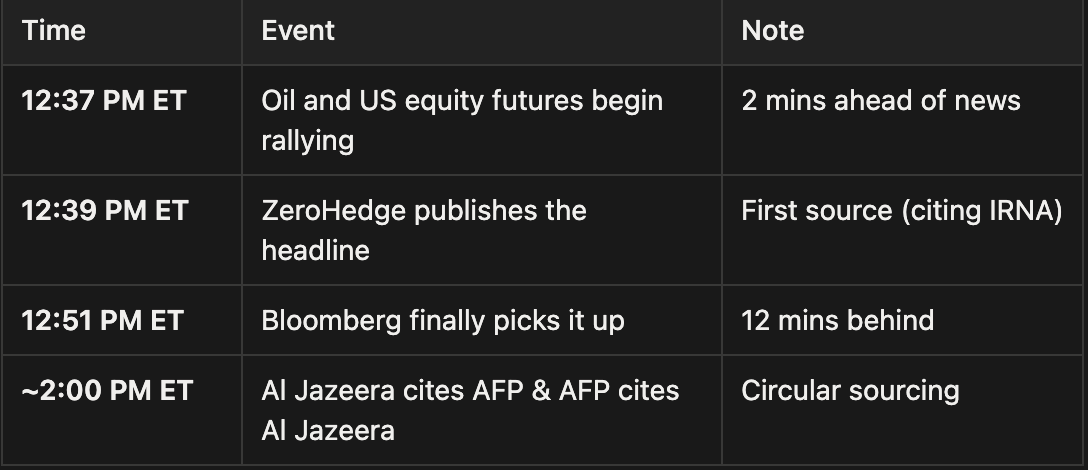
Here’s what the timeline actually looks like:
No original reporting. Bloomberg — with contacts everywhere — was 12 minutes behind a blog known for running unverified content.
And IRNA’s official Twitter? As of yesterday afternoon, no record of the statement. Nothing.
The headline had no primary source.
The President Has No Power
Even if the quote was real, it doesn’t matter.
Iran’s president is a decorative vase. The real power sits with Supreme Leader Mojtaba Khamenei and the IRGC — the same people who have zero incentive to end the war while Hormuz remains their best leverage. The IRGC decides when this war ends — not the president, not the foreign ministry.
Iran’s foreign minister has already said it publicly: “trust level is at zero” and there is “no truth to the claim of negotiations.”
The person who supposedly signaled peace cannot deliver peace. The market priced in a ceasefire that the person quoted has no authority to offer.
We’ve Seen This Before
In 2022, during the Ukraine war, FT, WSJ, and Bloomberg took turns running ceasefire rumors. Oil dropped. Equities rallied. The war continued.
Same playbook. Different war.
A well-timed rumor, a low-credibility first source, circular media amplification, and a market that desperately wants to believe the pain is over.
And underneath it all — a 2-minute head start. Correlation isn’t proof, but that timing is worth asking about.
What’s Real
Brent is pushing $115–$120. Up over 60% since February 27.
Hormuz is still physically closed. No deal. No timeline. No mechanism for reopening that doesn’t involve either a US military operation or an Iranian concession nobody in Tehran has the authority to make.
6 to 8 more weeks of this and $150+ becomes the new floor.
Yesterday’s rally was not a signal. It was noise — possibly manufactured noise.
The Trade Hasn’t Changed
Oil dips are entries.
Equity bounces are exits.
And the longer this drags on, the higher the floor becomes.
Boots on the ground isn’t a choice. It’s an inevitability.
No news. No noise. Just signal.
I look at BTC block deals. That’s just my thing.
I’m observing a lot of short puts targeting April 17. Which is weird, because the theta isn’t juicy enough. I’d normally categorize this trade as bullish conviction. But wait—I’ve seen this not too long ago.
January 2026. The Clarity markup was around the corner, and short puts piled in.
Three days before Jan 16—weekly expiry for Deribit and monthly for US equities—the market jumped from 90k to 98k.
Short puts were in the 80–90k range, which seemed like a wise trade back then. After Jan 16, BTC dropped, but sentiment remained bullish, with the Clarity Act markup nearing. But as prices started falling, dealers began to feel the stress. They hedged with longs on perps.
The Clarity Senate markup was originally planned earlier, but got postponed toward the end of January. The January monthly contract expired on the 30th.
When the January contracts expired, dealers didn’t give a damn. Long puts expired, and the relevant long hedges got dumped, pushing the market down to 60k.
I see the same setup here. I see a lot of short puts planting a bomb to take us down in April.
We have:
1. The Clarity Act, which isn’t guaranteed
2. Failing macros
3. A squeeze rally
—
special thanks to Garrett, helping the audience to distinguish noises and signal.
Positioning doesn’t predict direction. It defines the exit