

1. Hormuz has no solution
From day one of the war, we kept mentioning the duration has not been priced in. Hormuz got locked down by Iran's cheap, asymmetric weapons and the global shipping insurance system. Looking back, the framework held up. Hormuz has now been effectively closed for three months straight. Our call was never "this ends fast." It was "this lingers." And that part has played out.
2. Oil, we got out at the top
We had argued early on that the chokepoint could push oil to a high level, and with hindsight we closed our position almost right at the peak of this leg. The exit, on April 29 to April 30, turned out to be a very good call.
Why didn't it go higher? Everyone started releasing oil from both strategic and commercial reserves, and the US stepped in as the supplier of last resort, which together cushioned the gap. From here, oil might still have room to run, but the risk to reward is no longer attractive. Even if it rises, the hit to the US stays limited: the US is a producer itself, and households in developed economies absorb higher prices more easily. The real pain falls on importers with thin reserves, especially the poorer ones. Economies like India, where the current account and currency are already fragile, take it on the chin first — a case we've leaned on many times in earlier work.
3. Equities and the VIX, the de-risking bias and the great AI decoupling
US households hold ~47% of financial assets in stocks, above the 2000 dot-com peak, so a falling market forces the president to walk policy back. History gives two strike prices: a VIX near 50 triggered last year's tariff climbdown, and a VIX near 30 triggered the dovish Iran turn two months ago. That de-risking bias flips at those thresholds.
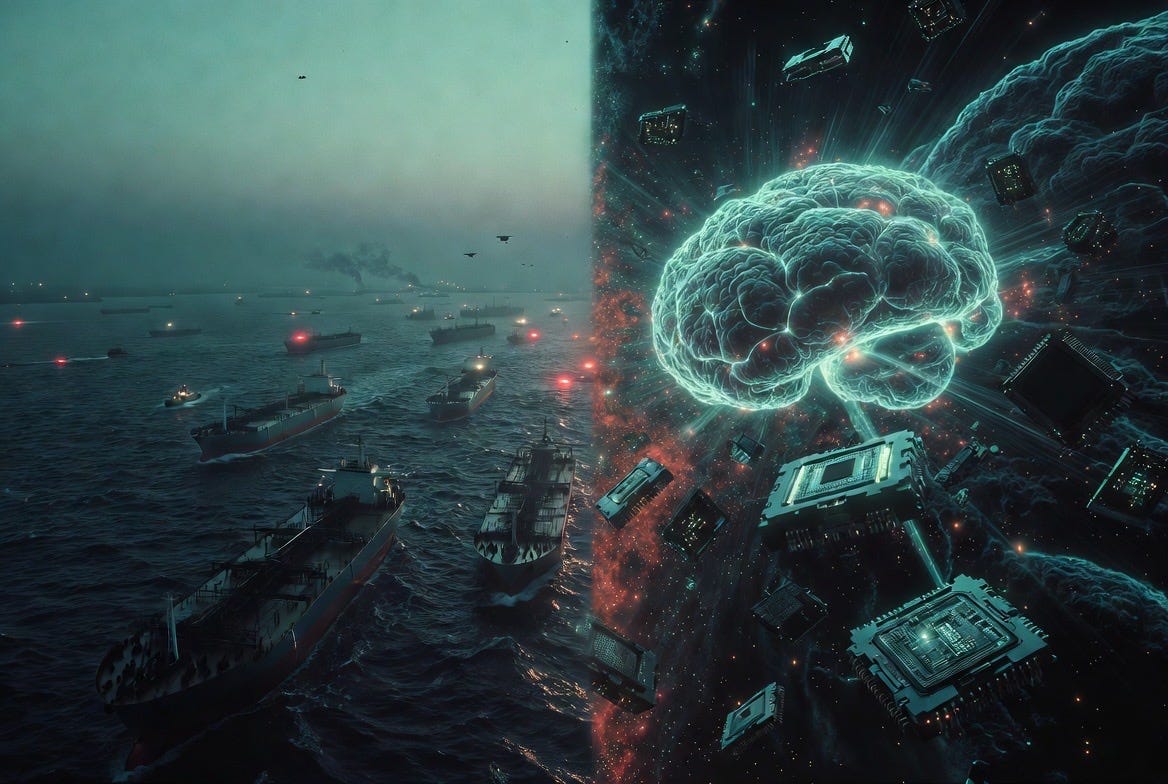
AI has made the market numb to oil. Since the late-March ceasefire signals, US equities have decoupled from the shock; the chip rally and better earnings offset the energy hit, and Hormuz faded at the margin. We underestimated this.
This new era is still early. Short term, AI carries real volatility risk — stretched valuations, crowded positioning, a narrative running ahead of itself — so a pullback can come anytime. But zoom out and we're at the beginning: compute supply can't meet demand, and the build cycle for chips, power and data centers has only just started. Short term swings are noise; they don't change the direction.
The paradox is that the stronger the market, the less pressure to force a peace deal. With no market pain, the hawks sound more convincing, and the Hormuz talks keep stalling. Peace now feeds the US mostly through bonds and inflation expectations, not equities, while the hardest-hit oil importers aren't even at the table. The people paying the cost have no voice, and that's what keeps the standoff alive.
4. Gold, not a war hedge but a ticket off the dollar planet
Why did gold pull back after the war? Because war hedging was never the main driver — we laid this out in Day 22 of Hormuz: The First Crack in $39 Trillion. The real driver these past years was central banks: over a thousand tonnes of net purchases a year from 2022 to 2024, led by Poland, Turkey, India and China, motivated by de-dollarization and hedging sanctions risk. That's structural demand, not a war spike.
Gold's real role is a hedge against holding dollars itself. If the dollar ever suffers a deep, sustained devaluation, gold is one of the few tickets off the dollar planet. So it gets supported as the odds of major dollar debasement tick up from zero; there's no second currency ready to take over settlement, and gold is the vehicle for that. Short term it still swings with real rates and the dollar, but that's noise — it doesn't change the long term role.
5. Crypto, the liquidity tide is going out, but respect the cycle
The turning point was last year's 10/10: crypto liquidity dried up and no fresh money came in. Where did the money go? AI stocks became a new "crypto market" of their own, with some names even acting like meme coins, and next to that crypto lost its shine and money got pulled out.
Still, respect the cycle. This is just the old rule playing out — the bull ran too far, so now we're in a bear, and there's no need to be overly pessimistic. The bounces in bear market could still go higher. But don't kid yourself either: that doesn't mean money flows back and we're suddenly in a bull again. The next bull still has to wait for the cycle, so stay patient.
6. The next trade
The market never runs short of opportunities. For capital and individuals alike, the AI era is a once-in-a-lifetime chance. Even a bubble is often the only door an ordinary person gets to walk through: a bubble means dislocated pricing and that mess is exactly what leaves room for the people who come later. If markets were always efficient, maybe only a handful like Buffett would keep making money.