

Trump took Hormuz.
Not with a peace deal. Not by reopening the strait. By doing the opposite: shutting it down himself.
Sunday night, after 21 hours of failed talks in Islamabad, Trump posted on Truth Social: “Effective immediately, the United States Navy will begin the process of BLOCKADING any and all Ships trying to enter, or leave, the Strait of Hormuz.”
CENTCOM confirmed: Monday 10am ET. All Iranian ports. All nations. No exceptions.
The world’s most important energy chokepoint just changed hands. For six weeks, Hormuz was Iran’s weapon. Tehran charged $2 million per transit. Allowed friends through, blocked enemies. Earned $139 million a day in oil revenue while its neighbors’ exports collapsed 80%.
Now the US Navy owns the chokepoint.
This is the single smartest tactical move Trump has made in this war. It is also almost certainly not going to work.
The Weapon Swap
There’s a concept that explains exactly what just happened: the chokepoint effect. Whoever controls a critical node in a global network holds coercive power over everyone who depends on it.
Before the war, the US was the guardian of Hormuz. Since World War II, the American navy kept the strait open so oil could flow and the global economy could function. That role was the backbone of Pax Americana. It’s why Southeast Asian nations trusted Washington’s freedom-of-navigation patrols in the South China Sea. It’s why Gulf monarchies parked their sovereign wealth in Treasuries.
Iran flipped the script on February 28. The moment US and Israeli jets hit Iranian soil, Tehran shut the strait. Selectively. Strategically. Turned a 21-mile waterway into the most expensive toll road on Earth.
For six weeks, Iran controlled the chokepoint. Iran had the coercive power.
Trump just took it back.
It’s a much smarter move than seizing Kharg Island. Seized oil cargoes could, in theory, be sold on the open market — cutting Tehran out of its own revenue stream. The playbook: blockade, interdict, squeeze.
On paper, the logic is clean. Iran was making more money during the war than before it. Its neighbors were bleeding. The only way to turn Iran’s economic advantage into a liability was to take the weapon away.
So Trump took it.
Why It’s Smart
Let’s give credit where it’s due. Two things make this move tactically brilliant.
One: it reverses Iran’s economics.
Before the blockade, Iran exported 1.7 million barrels a day. At war-inflated prices, that’s $139 million daily. More than pre-war. Iraq’s exports dropped 80%. Saudi rerouted everything through a pipeline running near max capacity. Iran was the only Gulf producer making money from this war.
The blockade, if enforced, zeros that out.
Two: it’s cheaper than invasion.
Seizing Kharg Island (Iran’s oil export hub) would require a ground force sitting on hostile terrain within range of every Iranian missile. A naval blockade operates at arm’s length. The US already has three carrier groups in theater, 18+ guided missile destroyers. The infrastructure is there.
So what’s not to like?
Hold that thought.
The Real Shift
Before we get to the problems, it’s worth sitting with what just changed at a level above tactics.
For six weeks, the United States has been reactive. Iran shut Hormuz; the US called for talks. Iran set transit fees; the US complained. Iran selected who passed and who didn’t; the US watched. The ceasefire was Iran’s framing. The Pakistan venue was Iran’s preference. The 10-point proposal was Tehran’s opening bid.
The blockade breaks that pattern. For the first time since February 28, Washington is setting the terms of engagement — not responding to Tehran’s.
This matters more than it looks.
Controlling a chokepoint isn’t just about who has ships in the water. It’s about who the world believes is in charge. For six weeks, every shipping company, every insurer, every oil trader priced their risk around a single assumption: Iran decides who sails through Hormuz. As of Monday 10am ET, that pricing anchor flipped. America decides.
Whether the blockade leaks — and it will — is almost secondary. What matters is the narrative recalibration. Markets, allies, and adversaries all adjust based on who they believe holds the initiative. And right now, for the first time in this war, that’s Washington.
Here’s the part worth sitting with: the US has spent six weeks looking like a superpower that started a war it couldn’t control. Every TACO cycle — the maximalist threat, the last-minute walk-back, the “ceasefire” that wasn’t — reinforced the perception that Trump was improvising. The blockade is the first move that looks like strategy rather than reaction. It’s the first time the US has dictated the tempo instead of responding to it.
That’s not nothing. In a conflict where perception shapes escalation dynamics as much as missiles do, the question of who holds the initiative is itself a market-moving variable. It changes how allies hedge. It changes how Beijing calculates. It changes how Tehran’s internal factions argue about what comes next.
But seizing the initiative is not the same as winning. And the cost of this particular initiative may be larger than the move itself.
Why It Won’t Work
Here’s the problem, stated plainly: the blockade assumes economic pressure will force Iran to the table. It won’t.
Iran has 88 million people, a battle-hardened Revolutionary Guard, a nuclear threshold capability, and proxy forces from Lebanon to Yemen to Iraq. This is not a regime that folds under financial squeeze.
Four reasons.
1. Iran won’t surrender. It will escalate.
Bloomberg Economics published their assessment within hours of the announcement. Their read: Iran will treat the blockade as an act of war. The two-week ceasefire is effectively dead. IRGC hardliners will find attacking US ships in the strait “irresistible.”
IRGC’s own statement confirms this: any military vessel approaching Hormuz “under any pretext” will be considered a ceasefire violation and “will be dealt with severely.”
Supreme Leader Khamenei posted on Telegram: “Iran will definitely bring the management of the Strait of Hormuz to a new stage.”
That’s not the language of a regime about to fold.
2. China won’t let Iran die.
China imports 80% of Iran’s oil. Beijing has no interest in watching its primary alternative crude supplier get economically strangled by the US Navy. Bloomberg Economics flagged the obvious lever: China could use its dominance in rare earth supply chains as counter-pressure on Washington.
Xi just helped broker the ceasefire. He has $270 billion invested across the Middle East. The last thing he wants is for Trump to control who gets oil and who doesn’t.
Our read: China will find ways to keep Iranian oil flowing. Shadow fleets, ship-to-ship transfers, overland routes through Pakistan and Turkey. This is what happened under every previous round of Iran sanctions. The blockade makes it harder, not impossible.
3. The blockade has a leak.
CENTCOM’s own statement contains the escape hatch. Read it carefully:
“CENTCOM forces will not impede freedom of navigation for vessels transiting the Strait of Hormuz to and from non-Iranian ports.”
So a Chinese tanker sailing from an Omani port through Hormuz to Shanghai? Not blocked. The US is only blockading Iranian ports, not the strait itself. That distinction matters. Iran-linked vessels flying flags of convenience, loading at non-Iranian terminals, routing through third-party ports: the workarounds exist.
Most countries’ oil export infrastructure is concentrated and exposed. Iran’s is distributed — and it has six weeks of practice running a grey-market oil operation.
4. The escalation ladder goes both ways.
This is the part that should keep you up at night.
If the blockade actually hurts Iran’s revenue, Tehran has options that go far beyond Hormuz.
Red Sea. Iran’s Houthi proxies in Yemen have already demonstrated they can disrupt Bab el-Mandeb, the chokepoint at the southern end of the Red Sea. In 2023-24, Houthi attacks forced global shipping to reroute around Africa. Bloomberg Economics warned: “Blockade may trigger Houthi action against Bab el-Mandeb.” Saudi Arabia just reopened its Red Sea export pipeline. Bad timing.
Gulf infrastructure. Iran has already struck energy infrastructure across the region. The 2019 Abqaiq attack took out half of Saudi production with drones that cost a fraction of a Patriot interceptor. If Iran decides “nobody sells oil,” the tools are cheap and proven.
Nuclear breakout. This was the reason the talks collapsed. Vance said Iran refused to commit to not pursuing a nuclear weapon. If Iran concludes that economic strangulation is coming regardless, the incentive to sprint toward a weapon only increases.
The logic is cold but clear: a cornered regime with nothing to lose doesn’t negotiate. It escalates.
The Paradox
Here’s where it gets interesting for markets.
The blockade is designed to end the war faster by squeezing Iran’s economy. But the most likely effect is the opposite: it extends the war by eliminating Iran’s incentive to negotiate.
Before the blockade, Iran had leverage (Hormuz) and revenue (oil exports). It could afford to talk. It had something to trade.
After the blockade, Iran loses its revenue but doesn’t gain anything. Hormuz is no longer Iran’s to offer. The only thing Iran has left to bargain with is its nuclear program and its proxy network. Neither of those is something Tehran gives up voluntarily.
The diplomatic space just got smaller, not larger.
There’s a deeper paradox, too. By blockading Hormuz, the United States just violated the principle it spent 80 years defending.
Ask the question plainly: if the US is willing to shut down Hormuz when it suits American interests, what stops the PLA Navy from pushing things a bit farther in the South China Sea? What stops anyone?
The US didn’t fail to keep Hormuz open. It chose to close it. That’s a different thing. And the precedent it sets is worse.
America was the lock. Now America is the key. And once you’ve shown the world that the guardian of the sea lanes is willing to weaponize them, you can’t un-show it.
Four Scenarios
We don’t predict. We prepare. Here’s the decision matrix.
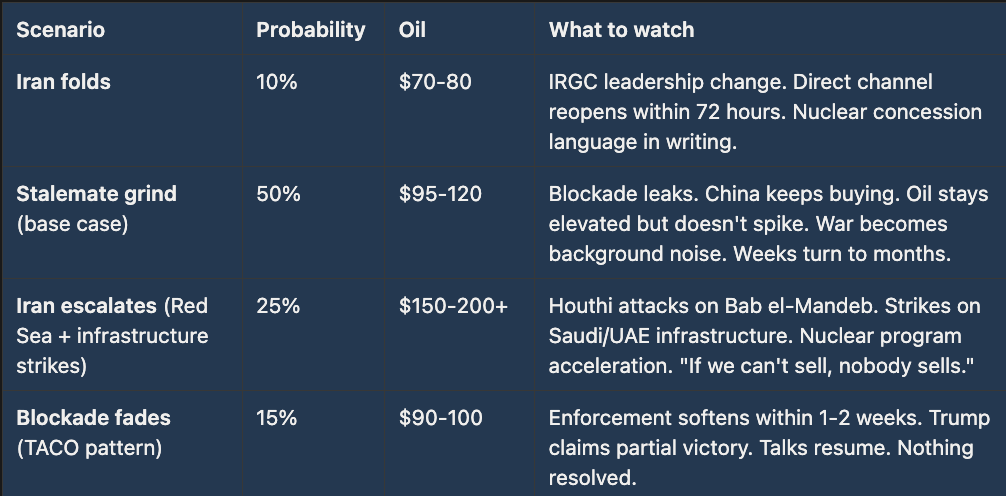
Our base case: Scenario 2. The stalemate grind.
Iran doesn’t fold because it can’t. Surrendering on nukes and Hormuz would end the regime. China keeps the economic lifeline alive through workarounds. The blockade becomes another layer of pressure, not a knockout blow. Oil stays in the $95-120 band. The war grinds on.
But here’s what matters for positioning: Scenario 3 is a 25% probability tail event with 3-5x the market impact of the base case. That asymmetry is why we stay long crude, long gold, long defense. The expected value of the tail is larger than the expected value of the base.
What We’re Watching This Week
Monday 10am ET: Blockade goes live. First 24 hours of enforcement data. How many ships are turned back? Does China test the perimeter?
Iran’s response: IRGC statement said any approach is a ceasefire violation. Watch for drone or missile probes. First shots fired at a US vessel = Scenario 3 accelerates.
Oil open: Brent futures Sunday night. The gap-up tells you how much the market believes the blockade is real.
China’s move: Does Beijing issue a public statement? Does it send naval escorts for its tankers? The shadow fleet activation timeline is the key variable.
IMF Spring Meetings (Apr 13-18): Global finance ministers in Washington. The hallway conversations matter more than the communiqués. Are they coordinating a response, or is everyone on their own?
The Bottom Line
Trump just made the smartest move of the war. He took Iran’s weapon and turned it against them.
But smart isn’t the same as effective.
The blockade works if Iran folds under economic pressure, accepts US terms, gives up its nuclear ambitions, and reopens Hormuz on Washington’s schedule.
Iran will not fold. It has proxies across four countries, a nuclear threshold program, an 88-million-person population with a revolution-forged national identity, and a patron in Beijing that will not let it be strangled.
The most likely outcome: the blockade becomes another chapter in a war that has no clean ending. Oil stays elevated. The cascade continues. The world adjusts to a new normal where the country that built the global shipping order is now the one disrupting it.
This is not a stable equilibrium. Something will break — an IRGC provocation, a Chinese escort convoy, US boots on the ground, a Trump walk-back, a second round of talks that nobody expects. The blockade is a move, not an endgame. And every move in this war has triggered the next escalation faster than the last.
The market has priced the blockade. It has not priced what comes after.
Garrett’s Signal covers macro, war, and markets at the intersection where most analysis stops.
No news. No noise. Just signal.