

The world is short 20% of its oil. In theory, everyone tightens the belt a little and the economy keeps turning.
That’s not how scarcity works.
When a critical resource goes into deficit, people don’t ration. They hoard. They speculate. And the ones with surplus? They wait for you to collapse, then buy your best assets for pennies.
Those three behaviors turn a manageable gap into a civilization-level problem.
Hoarding, speculation, and vultures
Hoarding comes first. The moment scarcity hits the headlines, everyone panic-buys. Not because they need it. Because they’re afraid. They aren’t buying barrels. They’re buying the feeling of safety. That panic alone can double the effective shortage.
Then comes speculation. Oil gets scarce, traders pile in, prices detach from fundamentals. This isn’t theory. It’s the iron law of commodity markets. Every energy crisis in history has played out this way.
The last layer is the cruelest: waiting for you to die.
Why those with oil aren’t selling
Oman spot crude is trading at $150 to $200 a barrel. But oil-short countries can’t always buy. Dollar-rich players have already locked up supply.
Some countries are sitting on full reserves and still won’t sell to their neighbors.
Why? Because they see a bigger play. Wait for debt crises. Wait for social unrest. Then acquire the best companies on earth at 80% off. A firm worth $50 billion in normal times might go for $5 billion when a country is falling apart. No soldiers required.
Berkshire is sitting on nearly $375 billion in cash. An all-time record. The buildup started long before this war, twelve straight quarters of net selling. But the timing of the deployment is what matters.
What is Buffett waiting for?
This playbook is 3,000 years old
Genesis 47. Joseph helps Pharaoh stockpile grain during seven good years. Then seven years of famine hit. Egyptians pay with money first. When the money runs out, they trade livestock. When the livestock is gone, they hand over land.
By the end of the famine, Pharaoh owns almost everything in Egypt. No war. No violence. Just control of a scarce resource, and patience.
The Hormuz blockade runs the same logic. Conquering a country by force takes hundreds of thousands of troops. Shutting one strait and waiting? That takes a navy and time.
Joseph, at least, was trying to save people. The players circling this crisis are not.
This is why a 20% oil deficit can kill the world. Not because there isn’t enough oil. Because some are hoarding it, some are trading it, and some are waiting for you to go under.
Collapse is instant
Most people think economic crises unfold gradually.
They don’t.
Lehman Brothers was operating normally the day before it filed. Silicon Valley Bank had no visible crisis 48 hours before it died.
Systemic collapse works like a bank run. When everyone trusts the bank, it functions perfectly. The moment confidence breaks, everyone withdraws at once. The bank doesn’t die slowly. It dies in 48 hours.
The global energy market is in this exact state right now. Everyone betting Trump resolves this quickly. Everyone still trusting the system. But if confidence cracks (reserves running dry, IEA confirming the gap has doubled) the selloff hits like a bank run. Not gradual. Instant.
Five weeks in
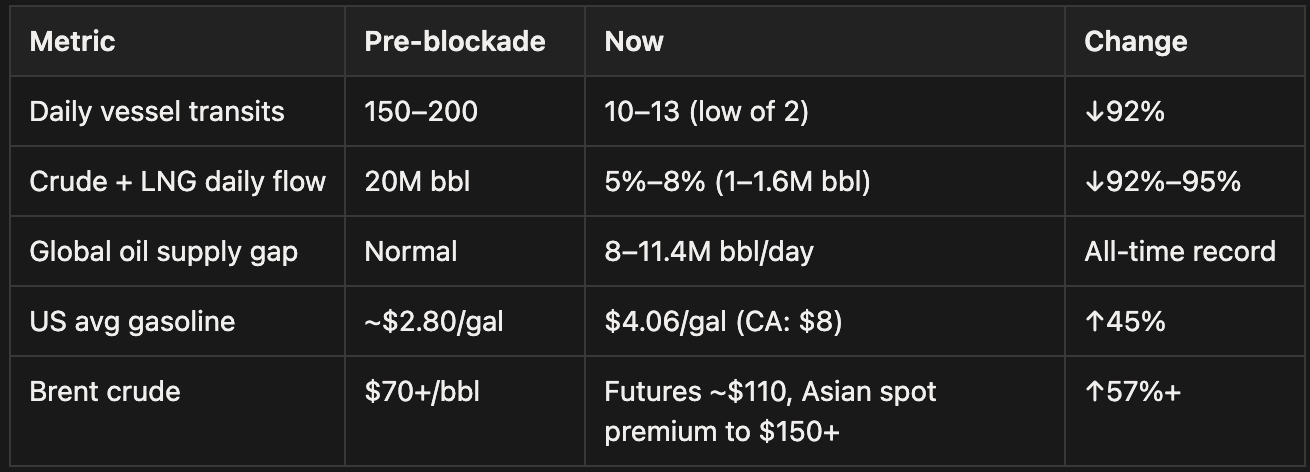
Note: Hormuz normally carries ~20M bbl/day, so the ~18–19M bbl/day lost from Hormuz is larger than the 8–11.4M bbl/day global supply gap. The difference is being partially filled by SPR releases, alternative pipeline routes (Saudi East-West, UAE bypasses), and non-Hormuz producers. That fill is temporary.
This already exceeds the 2022 Russia-Ukraine energy shock. It is being called the worst energy crisis in human history.
Our read: that label is probably right.
Strategic reserves: buffer time ≠ safety
Two things are keeping markets afloat: strategic petroleum reserve releases, and Trump’s rhetoric.
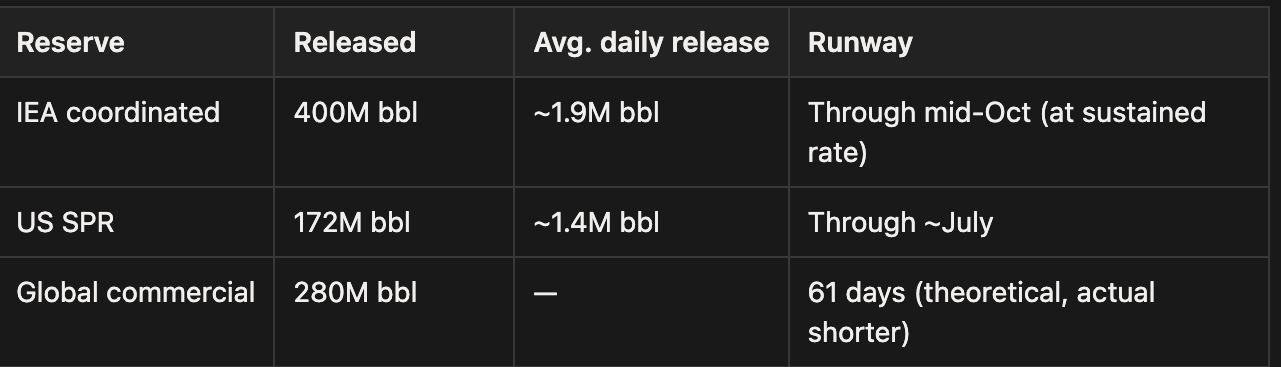
These numbers have problems:
SPR drawdown has a physical ceiling (about 2M bbl/day historically). Actual gap-filling capacity is well below the headline figures.
OPEC+ has 2.5 to 3.5M bbl/day of spare capacity on paper. But the export routes run through Hormuz. That capacity is stranded.
Several countries’ reserve figures involve delayed deliveries and overstated inventories.
Once the buffer period ends, the gap widens fast.
Reserves buy time. They don’t buy a solution. The market has a window. That window is closing.
Markets are sleepwalking
The market right now is surreal:
Israel just took its heaviest missile strike since the war started. Stocks: flat.
Chemical plants across Japan, Korea, Singapore, Thailand cutting output or shutting down. Markets: not pricing it.
Australia moved to work-from-home over fuel shortages. Korea imposed nationwide driving restrictions. Equities: still rallying.
Trump says Iran is negotiating every day. Iran denies it every day. Stocks: bounce.
Semis still ripping. AI plays still in vogue. Quant and algo trading amplifying the optimism. But look closer. A lot of things are already red. Everyone is just pretending not to see.
This divergence between markets and the real economy won’t last. It never does.
Iran’s hand
A lot of people are betting Trump fixes this fast. Look at Iran’s position.
The IRGC has said it plainly: “The Strait of Hormuz will not open because of Trump’s absurd performance. We have not conducted any negotiations and will not do so.”
Then there’s also the communication problem. Senior leadership won’t touch phones or encrypted apps for anything operational (Israel killed Haniyeh in Tehran, blew up Hezbollah’s pagers — the paranoia is justified). So real communication between Tehran and Washington runs through intermediaries: Oman, Iraq, Swiss back-channels. Each round trip takes days.
Iran’s calculus
Iran doesn’t need to win. It needs to outlast.
The strait is its biggest card. It has found America’s soft spot.
Russia is backing it. China is providing “humanitarian aid.” It’s not going hungry.
Strait toll revenues alone could bring in tens of billions per year.
If the US blinks or gets bogged down, Iran keeps the strait. The wealth that once belonged to Gulf monarchies flows to Tehran.
Trump’s bind
Don’t strike: The petrodollar system unravels.
Strike: Oil spikes further. A prolonged war means Gulf crude can’t ship. The money pipeline feeding US equities dries up.
The real risk: Sharp dollar devaluation. If the petrodollar loses its anchor, every dollar-denominated asset gets repriced.
Nobody in the White House has a clean answer for this. That’s the scariest part.
What to watch
US SPR weekly report. Reserve depletion rate is the most direct signal.
Brent spot vs. futures curve. Deep contango means the market is pricing a long shortage.
Trump’s tone. Rhetoric getting louder = situation getting worse.
Asian factory utilization. Chemical, auto, and semiconductor output drops are the leading indicator.
Fertilizer prices. More honest than oil prices, which are being distorted by verbal intervention.
IEA monthly report. If the mid-April update confirms buffer exhaustion, confidence could snap overnight.
The timeline
Based on Dallas Fed data: if the strait stays closed through Q2, annualized GDP contracts 2.9%. Multiple institutions have been revising recession odds upward.
The probabilities below are conditional: they assume the blockade persists into each phase. If the strait reopens earlier, later phases don’t apply.
Now → April 15: Reserves still flowing
Strategic reserves still being released. Trump still talking. GDP impact: minimal. If the April 6 “ultimatum” produces nothing, the gap starts widening fast.
Global economic breakdown probability: 20–30%
Late April → Early May: Reserves running dry
National reserves bottom out. IEA confirms the gap has doubled. Real-economy hits concentrate: fertilizer shortages, delayed spring planting, chemical shutdowns, LNG crunch, European industrial cuts.
Probability: 45–65%. This is the inflection.
Mid-May → End of June: Real economy deteriorates
Oil breaks $150 to $200. High prices suppress all activity. Countries scramble for Russian and Indian supply with limited success. Europe and Asia enter recession first.
Probability: 65–80%
After June: Systemic collapse
No alternative supply routes materialize. Stagflation plus unemployment plus central bank paralysis. Raise rates and $40 trillion in US debt becomes unserviceable. Hold and inflation runs away. Food crises. Social unrest. Gold probably hits new all-time highs.
Probability: 80–90%
Escalation scenario: If the US strikes Iranian energy infrastructure directly, add 20% to every phase.
The 1973 oil crisis. Lehman 2008. The Russia-Ukraine shock of 2022.
The pattern never changes. Before the data confirms it, everyone pretends not to see. After it confirms, the real selling begins.
We are in the “before.”
April 15 to 25 is the window. The ultimatum is the first catalyst. Strait reopens, we go back to normal. It doesn’t, or things escalate, and markets front-run the collapse.
The world doesn’t need to run out of oil to break. It just needs enough people to believe it might.
Garrett’s Signal · Macro · Geopolitics · Markets
No way iran is sending letters physically but has full access to X to send memes
MOS is running close to Brent, was watching it today, that’s def a signal, eyes on wheat and corn as well