

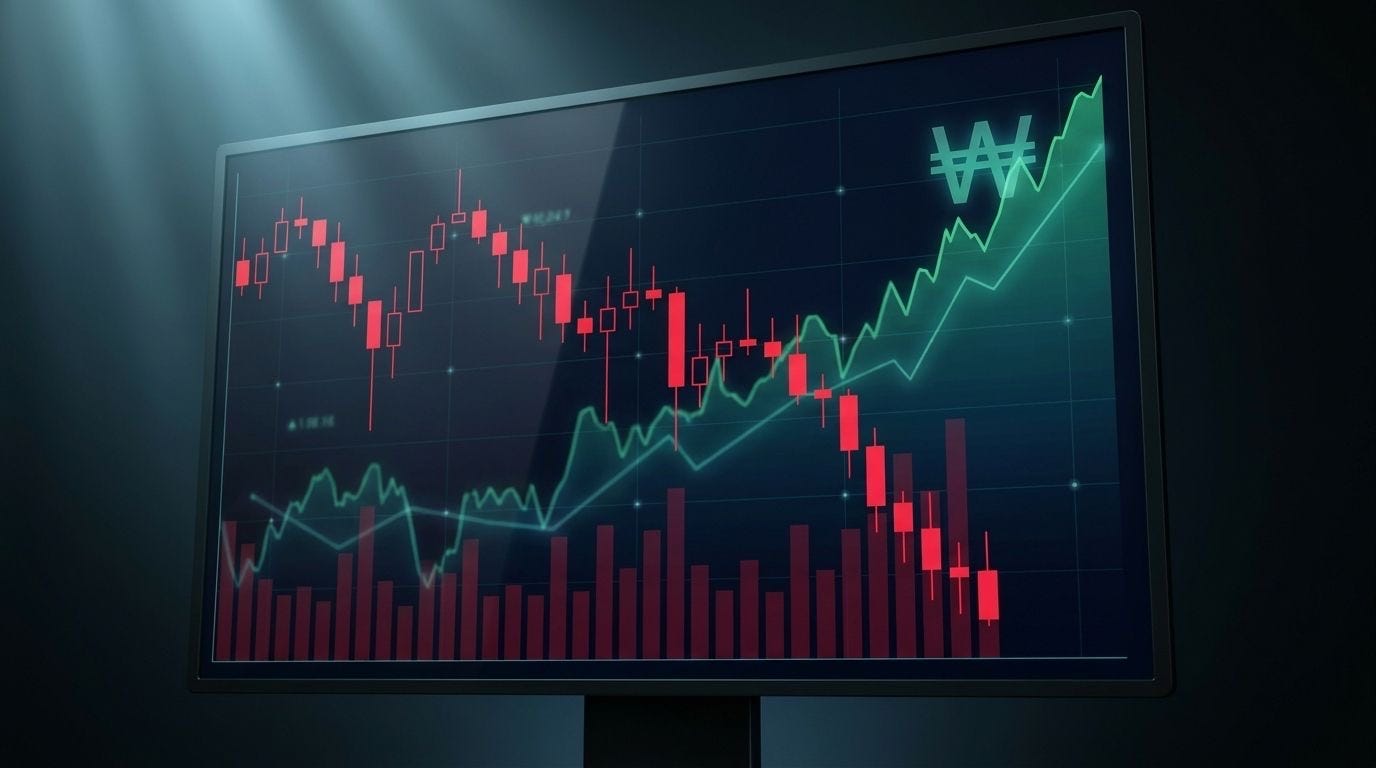
Last week we called memory ACCUMULATE while Korea was still smoking. This week Korea didn't stop burning — it accelerated. The Kospi fell 10.84% on Monday, then another 9.9% on Tuesday. Two consecutive circuit breakers. SK Hynix posted a record 60.5 trillion won in quarterly profit and the stock dropped 12.6%. Samsung fell 8%. The index is now 42% below its June peak.
Our answer: accelerate accumulation over the next two weeks.
That sounds backwards until you separate what crashed from why it crashed. The stocks fell because leveraged retail accounts in Korea got liquidated, not because AI data centers stopped ordering memory or because Micron's order book evaporated. Our Korea leverage monitor — the system we built to track exactly this kind of forced selling is flashing red. The forced liquidations could still be running, which means the window for scaled entry is still open.
And that's exactly why this is the highest-value buying window we've seen all year.
1. What Changed This Week
1. Korea crashed on leverage, not on fundamentals
The mechanical selling started Monday and hasn't stopped. Margin rules in Korea are automatic: when collateral falls below 140%, brokers issue a margin call the next day and force-sell at the limit-down price on D+2. Two consecutive -10% days guaranteed waves of forced liquidation into Tuesday and Wednesday.
Our system tracks the full picture: traditional margin loans, leveraged ETF flows, investor deposits, and forced selling volume. The conclusion is clear. This is a leverage flush, not a fundamental repricing.
Here's the tell that confirms it's not capital flight: the won kept strengthening through the entire crash. USD/KRW fell from around 1,550 in early July to 1,444 now. The currency rallied while stocks were in free fall. That's the opposite of what happens when foreign money abandons a market. In 1997, 2008, 2020 — every real crisis — the won collapsed as offshore capital sold stocks and converted back to dollars.
This time the won went up.
That means the selling pressure is coming from domestic leveraged longs being liquidated, not from a structural unwind. Our framework tracks this specifically: when forced selling dominates but the currency holds or strengthens, you're watching mispricing get created in real time.
Micron is trading below 6x this year's earnings. Its order book runs through 2028. SK Hynix just posted the highest quarterly profit in its history and controls the HBM capacity that every AI hyperscaler needs. The earnings didn't disappear. The orders didn't get canceled. The only thing that changed is the price.
Our read: this is the gift. Our system says the flush could still be active, which means the window is still open. You don't wait for the all-clear signal. You scale in while the opportunity is in front of you.
2. The hyperscalers haven't stopped spending
Nothing in the Korea crash changes the demand side. Alphabet just raised its full-year capex guide to $195–205 billion. Microsoft, Meta, and Amazon report next week. If their guides keep climbing — and we expect they will — the shovel sellers keep collecting.
The current phase is simple: hyperscalers are spending ahead of revenue, borrowing to keep building, and every dollar of that $700+ billion in capex lands on a supplier's income statement today. Memory, power, networking — they get paid now. The buyer's re-rating comes later, maybe quarters from now. The supplier's harvest is happening right now.
Korea's panic doesn't stop that. It just put the best-positioned suppliers on sale.
